
We are accustomed to the idea of an abundance of water on the Sunshine Coast. Our region boasts a seemingly endless supply of rivers, lakes, and streams that provide the lifeblood of our ecosystems and supply our drinking water, water for agriculture, and more.
Yet, we rely entirely on a natural cycle of precipitation, groundwater movement, and evapotranspiration to keep our systems in balance.
Part of that cycle is seasonal snowpack and the gradual melt that follows, and because of the climate crisis, we are experiencing seasonal variation unlike anything we’ve seen before. So what happens when we get less snow than normal in the winter, and what does that mean for our drought risk come summer?
The BC Ministry of Water, Land, and Resource Stewardship (WLRS) Snow Survey and Water Supply Bulletins for April and May 2026 paint a troubling picture for our region, one that demands our attention as we head into summer.
What the Snowpack Reports Are Telling Us
Each spring, the BC River Forecast Centre releases its Snow Survey and Water Supply Bulletins, tracking how much snow has accumulated in mountain watersheds across the province. The April 1st survey is considered the benchmark because by then, roughly 97% of the annual snowpack has typically accumulated. The May 1st bulletin then outlines how snowmelt is progressing and what to expect heading into the dry season.
This year, the numbers for our region, the South Coast, are alarming.
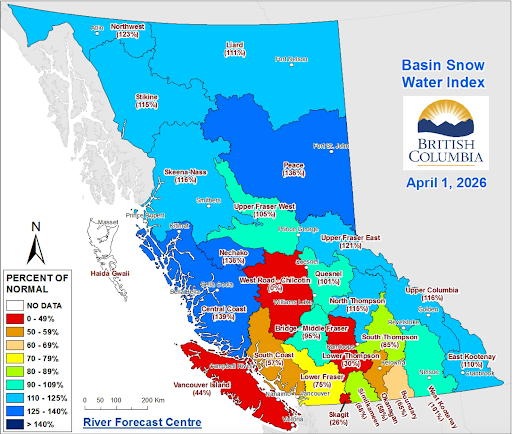
As of April 1, 2026, the South Coast’s snowpack basin index sat at just 57% of normal (based on the 1991–2020 average). By May 1, it had dropped further to just 45% of normal.
For context, on May 1st last year, the South Coast snowpack was at 74% of normal, already a cause for concern.
We are significantly worse off than we were a year ago.
The province-wide picture shows high variability: while northern and eastern regions maintained near-normal or above-normal snowpack, southern and coastal regions like ours fell dramatically short. Several snow stations in the South Coast region set all-time low records for snow water equivalent (SWE) this year, including on the Sunshine Coast.
On May 1st, the Chapman Creek station was 41% of normal (a record across 14 years of data), and the Edwards Lake station was 33% of normal (a record across 12 years of data).
Why So Little Snow?
The short answer is that we had plenty of storms this winter — just not cold enough ones. Understanding why requires looking at several converging factors.
First, a larger climate pattern was at play. In fall 2025, NOAA issued a La Niña Advisory, indicating the cool phase of the El Niño–Southern Oscillation (ENSO). La Niña years are typically associated with cooler, wetter winters on the BC South Coast, conditions that should, in theory, have favoured snowpack accumulation.
And yet, as the Weather Network reported in January 2026, winter simply did not show up on the South Coast, with Vancouver, Victoria, Comox, and even Abbotsford recording zero centimetres of snowfall through January 20th.
High winter temperatures pushed freezing levels to higher elevations and frequent warm atmospheric rivers either delivered rain to mid-mountain elevations or stripped away early snow accumulations. As an Environment and Climate Change Canada meteorologist explained, every time storms came in from November all the way into January, they brought warm air from the Pacific, which translated to rain even up in the mountains, preventing the snowpack from building.
And even when snow did build, the frequency of warmer storms washed much of it away.
Unfortunately, this pattern is increasingly evident due to climate change. Warmer fall and winter temperatures (and warmer air masses carrying moisture) cause precipitation to fall as rain rather than snow at higher elevations. And as the BC government’s climate analysis has documented, snowpacks in southern BC and across much of western North America have decreased over the last 50 years, with spring snowmelt and runoff starting earlier and increasingly long, dry summers following. That is to say, our snowpack accumulation this winter is no longer an anomaly.
A Faster Melt Than Usual
When snowpack is already below normal, early and rapid melting compounds the problem.
Typically, by May 1st, around 6% of the provincial snowpack has melted from its seasonal peak. This year, 15% had already melted by May 1, and by May 7, approximately 28% had gone. Spring arrived fast.
This rapid melt matters because it shifts the timing of water availability.
Like a natural water tower, snowpack stores water and then releases it throughout the spring and summer, when demand from ecosystems, agriculture, and human communities peaks. With rapid snowmelt, instead of a steady, gradual release of snowmelt feeding our streams and rivers through spring and into summer, water moves quickly through the system and is gone before the dry season peaks.
The result is lower stream flows later in the year, at the exact time when we and our ecosystems need them most.
What This Means for Our Summer
The concern now is drought.
The May bulletin notes that low snowpack, early snowmelt, and warm seasonal weather forecasts are “elevating drought hazards for this upcoming season, particularly along the southern coast and southern interior”.
Seasonal outlooks from Environment and Climate Change Canada indicate a greater-than-normal probability of above-average temperatures from May through July 2026, with the strongest signal exceeding 70–90% probability in some areas, centred over the South Coast and Vancouver Island.
Drought isn’t simply about drinking water running short, though we know from experience that this is a very real concern on the Sunshine Coast. In fall 2022, the District of Sechelt maintained a month-long state of local emergency as drought dried up the local water system.
Consistent droughts are also placing increasing pressure on BC’s aquifers — the underground layers of rock, gravel, and sand that store our groundwater — with natural water sources failing to recharge across the province.
Beyond drinking water, low soil moisture and reduced groundwater recharge make our forests dramatically more vulnerable to wildfire, and the BC Wildfire Service has already flagged the potential for an active spring wildfire season.
Our fish are also at serious risk. Low streamflows can be fatal for fish such as salmon, blocking migration pathways to spawning areas, while high water temperatures increase stress and can cause fish to die outright. As the Pacific Salmon Foundation has warned, low snowpack is likely to result in extraordinarily low flows by mid to late summer, even if we don’t have a particularly hot season, because snowpack is so critical to driving streamflows.
The Role of Human Activity
It’s important not to let the focus on seasonal weather patterns obscure the larger context: these conditions are being worsened by human activity, both globally through actions that exacerbate the climate crisis and locally through land-use decisions.
Forestry practices, particularly clearcut logging, have a significant and often underappreciated effect on watershed hydrology. When tree cover is removed from a landscape, the land loses its capacity to capture and slowly release precipitation. Instead of filtering through the forest floor into the soil, recharging groundwater and feeding streams gradually, water runs off quickly across exposed ground into waterways and eventually to the ocean. This reduces soil moisture, degrades watershed function, and creates a drier landscape more susceptible to fire.
Industrial water use is another piece of the puzzle. Current water pricing in BC does not reflect the true value of the resource being extracted. When industries pay very little for large volumes of water, there is little financial incentive to use it carefully or to innovate toward efficiency. Pricing reform that reflects the actual ecological value of water is long overdue.
We encourage our members to support the BC Watershed Security Coalition’s campaign to raise industrial water rates in BC and invest in long-term watershed security. Use the Coalition’s letter-writing tool to send a timely message to your MLA: https://watershedsecurity.ca/home/take-action/email-your-mla/
What We Can Do With This Information
It’s understandable to feel overwhelmed when confronted with data like this. But knowing clearly what we are facing allows us to respond more effectively.
At the individual level, this is a year to be genuinely thoughtful about water use through spring and summer. Conserve where you can, particularly during dry spells. Pay attention to local drought advisories and water restrictions if they are issued.
At the community and policy levels, we can advocate for land-use decisions that protect our watersheds. That means pushing for an end to clear-cutting in the headwaters and riparian areas that feed our streams. It means supporting forest management approaches that prioritize ecosystem function and long-term resilience over short-term timber extraction. It means calling for industrial water pricing that reflects the real value of this resource.
The numbers this year are serious, but we are better able to respond when we understand what we are up against. Our ecosystems possess remarkable resilience, and so do we.
Let’s harness that resilience thoughtfully and take action!