
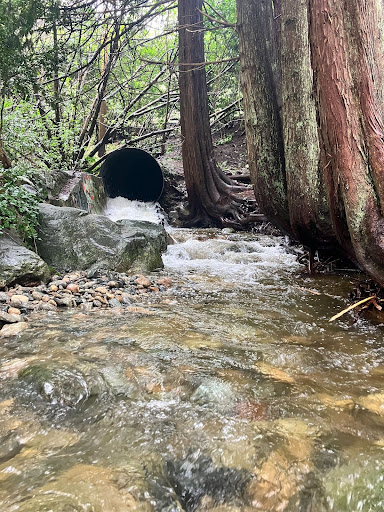
While the Lower Sunshine Coast may not boast large rivers, it is home to numerous smaller creeks and streams that flow through the landscape. Each of these waterways plays a vital role in our understanding of these watersheds and provides insights into the health of the environment, including water quality, aquatic life, and bank conditions. Together, these details help us assess the overall health of the watershed. Consistently monitoring streams is essential to protecting lands and waters on the Sunshine Coast.
Streams as Indicators of Watershed Health
A watershed is the entire area of land that drains water from the surrounding land—including runoff, groundwater, and all forms of precipitation—into a shared body of water, such as a lake or ocean. A healthy watershed filters and stores water, cycles nutrients, provides habitat for native flora and fauna, and offers resilience against climate change.
When something is amiss in the watershed—such as erosion, pollution, or biodiversity loss—streams often show the first signs of these effects. Monitoring our local streams offers a view into the overall condition of the watershed and helps connect human activity to ecological change. Critically, the data collected not only provides a permanent record for decision-makers to act on, but also justifies program improvements and supports the case for additional watershed protection measures.
What Is Stream Monitoring and What Do We Look For?
Stream monitoring involves conducting standardized, science-based surveys of freshwater ecosystems. SCCA partners carry out a range of surveys throughout the year, including:
- Monthly water quality assessments — measuring turbidity, dissolved oxygen, pH, and temperature. These measurements can reveal watershed-level concerns such as runoff from development, erosion, or temperature stress on aquatic life.
- Bi-annual juvenile fry counts — counting young fish to learn which species are present, where they live, and in what numbers. Salmonids such as Coho salmon and Chum salmon are considered indicator species: their presence signals good water quality and healthy habitat.
- Autumn spawner surveys — counting adult salmon returning to spawn. These surveys follow the same methods used by Fisheries and Oceans Canada (DFO) officers, and results are submitted to both the Pacific Streamkeepers Federation database and DFO.
- Stream morphology and habitat assessments — walking the stream to evaluate its physical structure, document erosion, identify barriers to fish passage, and record the condition of riparian vegetation.
The Principles of Stream Monitoring
For monitoring to be meaningful — and defensible — it has to be done consistently and rigorously. The SCCA is committed to the following practices:
Consistent methods. We follow standardized protocols developed by the Pacific Streamkeepers Federation and DFO, so our data is comparable year over year and can be contributed to provincial databases.
BACI monitoring (Before/After Control/Impact) will be conducted. Monitoring before and after restoration works at both impacted and control sites helps us meaningfully assess whether our actions are having the intended effect.
Proper documentation and quality control. All survey results are entered into the provincial Pacific Streamkeepers Federation database. Spawner counts are also submitted to DFO. All data is reviewed upon collection to ensure quality.
Community-based monitoring. SCCA’s stream monitoring programs are built on deep local expertise and a network of dedicated, skilled community partners. SCCA Freshwater and Marine Liaisons Dianne Sanford and Angela Kroning are central to stream monitoring efforts. They also act as advisors and mentors, participate in stewardship planning, and share invaluable background knowledge. The SCCA collaborates closely with the Sunshine Coast Streamkeepers Society, a local network affiliated with the province-wide Pacific Streamkeepers Federation. The SCSS works to develop, train, and support stream-keeping groups and activities across the Sunshine Coast. SCSS President Shirley Samples also leads monitoring and invasive species removal works for Roberts Creek and Malcolm Creek.
Monitoring and Restoration: Ch’ḵw’elhp–Gibson Creek and Malcolm Creek
In 2021, the SCCA convened a Fish Passage and Habitat Restoration Working Group to address a perched culvert blocking salmon access at Ch’ḵw’elhp–Gibson Creek on Sḵwx̱wú7mesh Úxwumixw (Squamish Nation) reserve lands. Partners include the Squamish Nation, Fisheries and Oceans Canada, the BC Ministry of Transportation and Transit, the Town of Gibsons, and local Streamkeepers groups.
Baseline monitoring documented restricted passage, simplified channel conditions, and invasive riparian vegetation. A temporary fish ladder was installed by DFO in September 2025. In 2026, channel rehabilitation will commence in order to enhance spawning gravels, add large woody debris, and replant native vegetation. Monitoring — including fish presence surveys, spawning observations, water quality testing, and invasive species assessment — guides design, protects fish during construction, and measures post-restoration response. Monitoring can also track emerging threats such as 6PPD-quinone from road runoff in near-urban watersheds.
Through the same working group, working closely with Sḵwx̱wú7mesh Úxwumixw (Squamish Nation), the SCCA is facilitating a culvert replacement and habitat restoration project at Malcolm Creek, led locally by Shirley Samples of the Sunshine Coast Streamkeepers. There, monitoring establishes pre-construction baseline conditions and documents ecological recovery following implementation.
Together, these projects demonstrate how structured monitoring strengthens restoration outcomes and long-term salmon stewardship.
Why Monitoring Matters: Connecting Data to Action
The data collected through stream monitoring is the foundation for the restoration and conservation work we do. Monitoring helps us understand how natural cycles, upstream events, and human impacts affect local rivers and streams over time. It reveals how everything is connected: logging in an aquifer recharge area, for example, can amplify runoff entering the system, increase erosion, and degrade habitat kilometres downstream.
Monitoring also helps us set priorities. When we identify erosion, barriers to fish passage, invasive riparian vegetation, or pollution sources, we can choose targeted restoration projects that will have the greatest impact. And once restoration work is underway, ongoing monitoring allows us to measure whether it is working.
Healthy streams support biodiversity— the full variety of life that makes our ecosystems resilient and self-sustaining. Native fish, aquatic invertebrates, riparian plants, birds, and mammals all depend on the health of our waterways. When streams are degraded, this web of life unravels. Industrial activities like logging and gravel mining in aquifer recharge areas can dramatically disrupt the natural water cycle, reducing groundwater recharge, increasing erosion and turbidity, and destabilizing slopes. Understanding and documenting these connections, through monitoring, is essential to making the case for watershed protection.
Get Curious!
Stream monitoring, at its core, is an act of noticing. The more closely and consistently we observe our local waterways — their clarity and temperatures, the fish returning each year — the better equipped we are to protect them. The observational record, built season by season by community members who care, connects individual watersheds to community-wide understanding and local action to provincial decision-making.
The Sunshine Coast Streamkeepers Society makes it possible for anyone to be part of that work. The SCSS offers training and hands-on volunteer opportunities for people at every level of experience — from first-time volunteers to seasoned streamkeepers. Every careful observer makes a difference!