
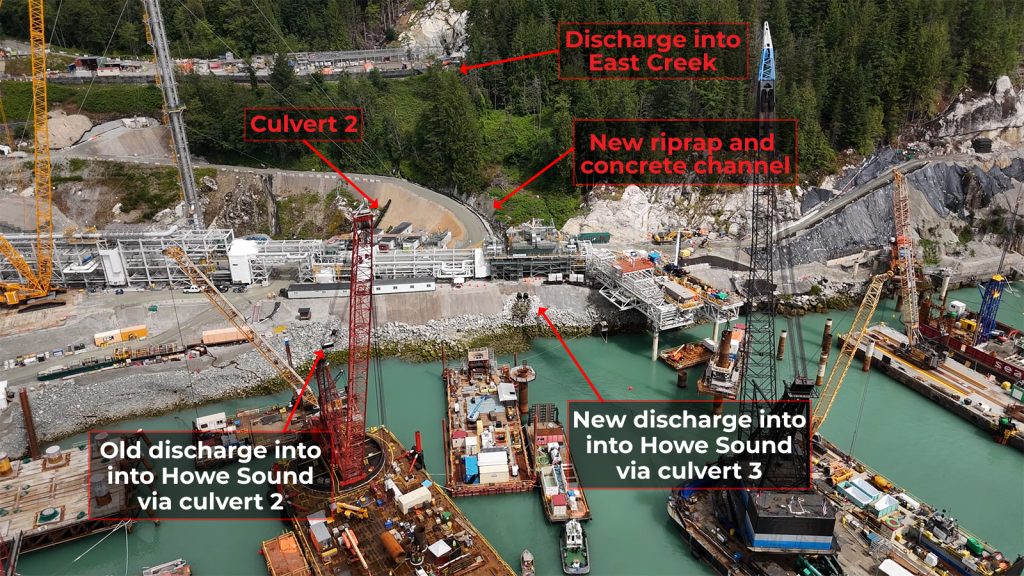
The Woodfibre site on July 3, 2026, showing the discharge point into East Creek, and the highly modified riprap and concrete channel, culverts and pipes which discharge directly into Átl’ḵa7tsem / Howe Sound 170 metres from the discharge point.
This summer, we continued our fight against the Woodfibre LNG project. Partnering with My Sea to Sky (MS2S), the SCCA submitted a comprehensive review to the BC Energy Regulator (BCER), calling on it to reject FortisBC’s application to amend its Waste Discharge Permit for the Eagle Mountain–Woodfibre Gas Pipeline.
Despite our efforts, the BC Energy Regulator granted the amendment.
Together with MS2S, we have filed a legal challenge of the permit with the Environmental Appeal Board of BC. Read on to learn more about the permit challenge process, what FortisBC and Woodfibre LNG have been up to over the summer, and what comes next in our fight to stop them.
What Is Woodfibre LNG and the FortisBC Pipeline?
Woodfibre LNG is a liquefied natural gas (LNG) export facility under construction near Squamish, on the shores of Átl’ḵa7tsem / Howe Sound, a designated UNESCO Biosphere Region. WLNG was approved in 2015 as a small-scale project with a capacity of 2.1 million tonnes per year, which was suspiciously one of the smallest LNG facilities ever proposed in BC.
To feed it fracked gas, FortisBC is building the Eagle Mountain–Woodfibre Gas Pipeline: a 50-kilometre, 24-inch high-pressure pipeline running through Squamish neighbourhoods, with increased-capacity compressor stations at both ends.
The final stretch of the pipeline is the most contested: a 14-foot-wide, 9-kilometre tunnel bored beneath the Skwelwil’em / Squamish Estuary, a designated Wildlife Management Area underlain by aquifers; it provides an estimated $12.6 million a year in ecosystem services like water filtration and flood mitigation for the District of Squamish. This estuary also serves as habitat for many creatures, including Chinook salmon, a critical food source for endangered Southern Resident Killer Whales.
Tunnelling through this sensitive ground has not gone smoothly.
The bentonite slurry used to bore the tunnel can pollute soil and surface water and is potentially lethal to fish. Drilling also risks striking potentially acid-generating rock, which is the geology that turned Britannia Mine into one of the worst sources of metal pollution in North America. Construction has already triggered ground collapses near the estuary, a shutdown by Squamish Nation after a drill bit got stuck in the mud, grout injection rigs had to be removed, and at least one additional stop-work order was issued.
What Happened Over the Summer
FortisBC has been over-polluting Howe Sound for two years.
FortisBC holds a permit from the BCER to discharge treated wastewater from tunnel drilling into East Creek. The water flows into Átl’ḵa7tsem/Howe Sound roughly 170 metres downstream, through a channel so heavily modified by riprap, culverts, and concrete that barely 50 metres of natural streambed remains. Within one week of starting discharge in June 2024, FortisBC exceeded BC Water Quality Guidelines, and it has continued exceeding guidelines for copper and aluminum for more than two years. Starting in February 2025, it also began exceeding its maximum permitted discharge volume —regularly by double or more.
FortisBC’s own water-quality reports reveal that it exceeded its permitted discharge volume on virtually every single day from April 2025 through June 2026. The ten highest-volume days on record all came in May and June 2026, after FortisBC’s water treatment system was supposedly upgraded to fix the problem. Of the water quality tests conducted between November 2024 and June 2026, only five met the existing copper guideline.
A federal minister let slip that Woodfibre LNG plans to triple capacity.
In March, at an energy conference in Houston, federal Minister of Energy and Natural Resources Tim Hodgson told investors: “I know Woodfibre has ambitions to double and triple the size of their production.”
Neither the company nor the government had previously disclosed any expansion plans, and Woodfibre LNG did not deny the substance of the comments when asked.
This isn’t new information to us. SCCA and MS2S have been tracking these signals for ten years, watching the infrastructure, permitting patterns, and amendments pile up around a project that claimed to be small, when the numbers didn’t add up. We called it years ago: a Trojan horse mega-project built quietly inside a small-project permit. It took a federal minister letting it slip to confirm what we had seen for some time.
Tripling the project would mean tripling direct facility emissions, significantly increasing tanker traffic through Howe Sound [4-post1][4-post3], and building well beyond anything ever formally assessed.
Instead of fixing the pollution problem, FortisBC asked to legalize it.
Rather than upgrade its treatment system to meet its existing permit, FortisBC applied to amend its waste discharge permit, asking to more than quadruple its allowable discharge volume from 1,500 to 6,815 cubic metres per day and to raise allowable copper to roughly 18 times the provincial guideline and aluminum to roughly 62 times the guideline. Combined, the increased volume and concentration limits would let FortisBC release approximately 72 times more copper and 248 times more aluminum into Howe Sound than its original permit allowed. On July 6, 2026, the BC Energy Regulator approved it.
How did the regulator and FortisBC respond?
The BC Energy Regulator’s public position is that the exceedances represent “minimal risk” and that treated effluent is “not expected to adversely affect fish, aquatic invertebrates or plant life.” [8] Its only enforcement action to date has been a single warning letter, issued in December 2025 — a full year after it was first notified of the violations — citing only the copper exceedances, with no mention of the ongoing volume violations, and no penalty attached.
FortisBC’s explanation is that higher-than-expected volumes of naturally occurring groundwater entered the tunnel during construction, requiring more treatment capacity, and that the amendment simply “reflects those site conditions.” The company maintains that discharged water will continue to be “treated, monitored and discharged in accordance with permit requirements.”
My Sea to Sky and the SCCA see it differently. As SCCA Executive Director Suzanne Senger put it: “Increasing pollutants and weakening water-quality protections violates the principles of a UNESCO Biosphere Region and risks undermining the hard-fought ecological recovery of Howe Sound. The regulator should make FortisBC stop work on the tunnel until they control the excessive flow of wastewater and upgrade the water treatment system to meet water quality guidelines.”
How Will These Changes Impact Nearby Ecosystems and Biodiversity?
Copper and aluminum don’t go away. Copper causes cellular damage and disrupts reproduction in aquatic species; aluminum disrupts respiratory function and the nervous system. Both accumulate in sediment and move up the food chain– into shellfish, prawns, crabs, fish, and eventually the marine mammals that depend on them.
This matters more in Átl’ḵa7tsem/Howe Sound than in some places, because Howe Sound is still recovering from decades of acid rock drainage from the Britannia Mine, which turned much of Howe Sound into what scientists once called a dead zone. Tens of millions of public dollars and decades of community, scientific, and Indigenous-led work have gone into bringing herring, salmon, seals, sea lions, and, for the first time in over a century, humpback whales back to these waters.
That recovery is exactly what’s now at risk. The shoreline between Woodfibre Creek and Foulger Creek, right next to the discharge point, has some of the highest documented densities of Pacific herring spawn in the region. Glass sponge reefs, which grow only 1–2 centimetres a year and can take centuries to recover from disturbance, have recently been rediscovered at the Woodfibre site. Southern Resident Killer Whales, threatened rockfish species, Steller sea lions, and countless other beings all rely on this ecosystem.
No one has assessed what all of this pollution adds up to.
Woodfibre LNG holds a separate discharge permit for its own wastewater treatment plants at the same site — one that already permits it to exceed guidelines for copper, lead, zinc, and vanadium, and one under which the company has repeatedly exceeded even those elevated limits, including for methylmercury, dioxin, and furan.
No cumulative effects assessment has ever combined FortisBC’s and Woodfibre LNG’s discharges to ask what the total contaminant load into Howe Sound actually looks like.
FortisBC’s case for the amendment doesn’t add up either. FortisBC’s water treatment plant is missing a basic pH-adjustment stage needed to properly remove metals, and FortisBC is using an aluminum-based coagulant (alum) that may be directly contributing to the very aluminum exceedances it’s now asking to legalize. The “background” reference sites that FortisBC used to justify its new limits are themselves contaminated by existing industrial activity or urban runoff, meaning the true baseline is likely being greatly underestimated, not maintained.
What SCCA and My Sea to Sky Are Doing About It
The SCCA and MS2S have been fighting FortisBC’s original discharge permit since 2023. This particular chapter of that fight includes a formal appeal to the Environmental Appeal Board. This summer, things moved quickly.
Our submissions to the BCER. After FortisBC published notice of its amendment application in February, MS2S and the SCCA got to work. On March 25th, we submitted a joint initial review of the application, backed by independent expert reports, and filed Freedom of Information requests for the underlying documentation. FortisBC’s justification for the amendment raised more questions than it answered, and we told the BCER we couldn’t properly assess it without the underlying documents. We pressed for that disclosure throughout the public comment period. It didn’t arrive until May, well after the March 7th deadline.
We told the BCER we were still working through the documents, engaging experts, and preparing a comprehensive submission. They knew a fuller submission was coming, but approved the amendment anyway, on July 6th.We submitted our detailed technical and legal review, with recommendations, on July 16th regardless, as it contains information the BCER needs to consider and should be on the record.
Together, our submissions demonstrate that FortisBC’s “application” did not even meet the minimum requirements of the applicable legal statutes.We’re calling on the BCER to reject the amendment outright, order an independent cumulative effects assessment, require real chronic and multi-species toxicity testing, and halt tunnel work until FortisBC’s treatment system can actually meet the guidelines it originally committed to.
Fighting for a stay. The BCER approved the amendment on July 6th anyway, and two days later argued that our original 2023 appeal was now moot. We immediately applied for a stay, which is essentially an injunction, to stop work while the Environmental Appeal Board rules on the underlying appeal. The EAB gave us just five days to prepare our case, and we filed our submission on August 14th. We’re now waiting on the Respondents’ submissions before the Board rules on the stay.
Getting the word out. Nearly 1,900 people have already sent letters opposing the amendment this year, more than the 1,465 who spoke up against the original permit back in 2023. Please, if you haven’t already, send a letter telling government officials to hold FortisBC accountable.
Local elections are coming. This fall, the SCCA, along with the Seniors Climate Action Network, will ask local election candidates to state their views on the impacts of Woodfibre LNG on our communities, and on the fate of the environment and climate. Please contact your candidates and let them know this issue matters to you.
What’s Next?
This post has focused mainly on FortisBC’s appalling violations of their wastewater discharge permits for the pipeline tunnel and the effects of those violations on Átl’ḵa7tsem/Howe Sound. The BC Energy Regulator’s decision to let FortisBC quadruple its pollution instead of forcing it to fix a broken treatment system directly violates the intent of the BC Environmental Management Act.
But wastewater is only one piece of what’s wrong with this project. There’s much more to consider, which we’ll be expanding on in upcoming blogs:
-
- The tanker question: If Woodfibre LNG triples in size, LNG tanker traffic through Howe Sound could rise from about 40 transits a year to as many as 240, with alarming consequences for marine animals and ecosystems. Boaters, paddlers, and swimmers, as well as anyone who depends on the ferry as a critical transportation corridor, could face huge disruptions in their ability to recreate in Howe Sound as well as count on reliable transit to the mainland.
- A system built to ignore the big picture: BC’s environmental assessment process reviews projects piece by piece, meaning a project can be approved at one scale while insidiously growing into something much larger without ever facing a full reassessment. The Province is currently proposing to make that process even faster. This must be challenged.
- The climate problem: LNG is primarily methane, a greenhouse gas roughly 80 times more potent than CO₂ over 20 years. The same climate change driven by projects like this one is already shrinking the snowpack that fills Chapman Lake, the source of most of our drinking water on the Sunshine Coast, and driving major climatological events (wildfires, droughts, slides) across BC and around the world.
- The dam connection: BC markets its LNG as “low carbon,” because it uses electricity for liquefaction and compression instead of burning its own gas on-site. But that label ignores the fracking, methane leaks, and combustion emissions once the gas is shipped and burned overseas. It’s greenwashing, and it’s not only driving climate change; it’s driving new mega dam projects in BC. Hydroelectricity demand for BC LNG already in progress, including upstream gas processing, already consumes more than three times the entire output of the $16-billion Site C dam. This electrification mandate is now driving a push to reopen the BC Clean Energy Act and gut protections on rivers across the province, including the Homathko River on the upper Sunshine Coast. More on that fight soon.
How You Can Help
The fight is far from over, and our continued efforts to stop FortisBC and Woodfibre LNG require sustained funding and support. Here are some ways you can support this fight and get involved.
Become a monthly (or one-time!) donor. Your support keeps this work going.
Send a letter. My Sea to Sky’s letter-writing tool makes it easy to tell decision-makers that this permit amendment should never have been approved.
Support our legal fight. My Sea to Sky and the SCCA are challenging project approvals for Woodfibre LNG and FortisBC. Can you chip in to help cover legal costs?
Thank you for reading this far! We know it’s a lot, and we appreciate your interest in understanding this complex issue. Thank you for caring. This work is only possible because of supporters like you.
Stay tuned to our emerging campaign to Stop New Mega Dams for BC LNG.