
British Columbians vote twice in one week this month.
General local elections are on Saturday, October 17.
The provincial snap election follows on Saturday, October 24.
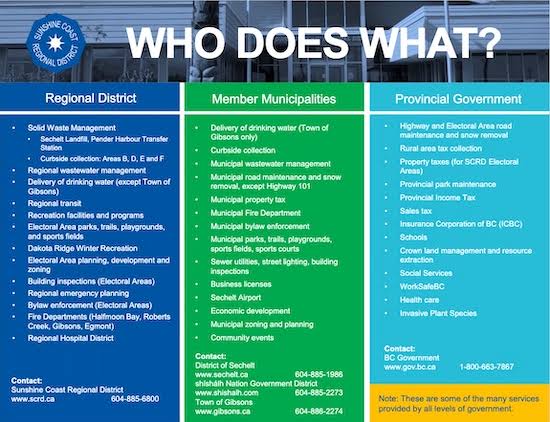
Each election cements decision-making powers at different levels of government, so it is worth clarifying what the Province and local governments each control.
The short version
- The Province has decision-making power over the Crown land and resources on the Sunshine Coast, and it sets the rules local governments must follow.
- Municipal councils and regional district boards decide how our communities grow, what gets built where, and which local services we fund.
- Both shape the future of our forests, watersheds, and shorelines, through different avenues. Ottawa and First Nations governments have their own roles too, covered below.
Knowing which ballot controls which decision helps us decide who we want to represent us.
Where the power comes from
The Province gets its power from the Constitution. Local governments get theirs from the Province.
Canada’s Constitution Act, 1867 divides law-making between Ottawa and the provinces. Provinces control public (Crown) lands, non-renewable resources, forestry, electricity, property and civil rights, hospitals, education, and “municipal institutions.” The Constitution does not recognize local governments as an order of government. They exist because provincial law creates them, and the Province can change their powers by passing a new law.
In BC, two provincial statutes do most of that work:
- The Community Charter sets out municipal powers. It recognizes municipalities as an order of government within their jurisdiction, and it says their powers must be interpreted broadly.
- The Local Government Act is the main law for regional districts. It also includes powers shared with municipalities, including land use planning, zoning, and rules for local elections.
Vancouver operates under its own Vancouver Charter, and the Islands Trust operates under its own Act. On the Sunshine Coast, the Town of Gibsons and the District of Sechelt are municipalities, and the Sunshine Coast Regional District (SCRD) governs the rural electoral areas and delivers regional services such as water. The shíshálh Nation Government District has its own legislated status (more below).
The Province grants local power and can take it back.
Ottawa also has a role. The federal government oversees fisheries habitat, navigable waters, ports, and federal impact assessments that affect our shoreline and large projects. This article focuses on the two ballots you will cast, but decisions here often involve all three levels of Crown government, plus First Nations governments.
What the Province decides
The Province decides what happens on Crown land, which covers about 94% of BC, and sets resource rules everywhere. On the Sunshine Coast, that means much of the forest above our towns, the water in our creeks, and the shoreline below the high-tide line. Not all of it is Crown land, though. Some forested land is private (see the Chapman Creek example below), but the Province still sets the rules for how it can be logged.
| Area | What the Province decides | Key provincial law |
| Forests | Who logs, where and how much on Crown land, including BC Timber Sales and the annual allowable cut; the rules for private managed forest land | Forest Act; Forest and Range Practices Act; Private Managed Forest Land Act |
| Crown land and foreshore | Tenures and leases for docks, marinas, industry and recreation | Land Act |
| Mineral claims | Who can stake mineral claims on Crown land, and what consultation comes first | Mineral Tenure Act |
| Water | Licences to take surface water and groundwater, and flow protection for fish | Water Sustainability Act |
| Major projects | Environmental assessment of mines, pipelines, LNG and large dams | Environmental Assessment Act |
| Energy | Hydro, private power projects, LNG and pipeline permits through BC Hydro, the BC Utilities Commission and the BC Energy Regulator | Clean Energy Act; Energy Resource Activities Act |
| Parks and wildlife | Provincial parks, protected areas, hunting and wildlife management | Park Act; Protected Areas of BC Act; Wildlife Act |
| Pollution | Permits for waste discharges to air, land and water | Environmental Management Act |
| Farmland | What can happen on Agricultural Land Reserve land | Agricultural Land Commission Act |
| Highways | Provincial roads, including Highway 101 | Transportation Act |
| Health, education, policing | Hospitals and health authorities, school funding and curriculum, the RCMP contract | Health Authorities Act; School Act; Police Act |
The Province also sets the rules for local government.
It sets their powers, their election rules, and the limits on what they can tax. When it wants a different outcome, it changes the law. Bill 44 (2023) required many local governments to allow three or four homes on most single-family lots, and up to six near frequent transit. When some councils resisted, the Province said it would use a ministerial override and later gave West Vancouver an ultimatum: adopt the zoning or let the Province do it.
The Infrastructure Projects Act (Bill 15, 2025) lets Cabinet designate projects as provincially significant. Where local permitting causes delays, the Province can consult the local government, seek agreement, and then step in if no resolution is reached.
Proposals to limit local review are also on the table. A private member’s bill from an NDP MLA, Bill M216 (the Professional Reliance Act), would have required local governments to accept technical submissions certified by registered professionals. The Union of BC Municipalities opposed it; the BC NDP government chose not to pursue it. It did not make it into law.
The Province holds the land, the water and the rulebook.
What local governments decide
Local governments decide how land inside their boundaries is used and which services residents get. Those powers are real, and on developing private land, they are often the strongest environmental tools available.
| Area | What local government decides | Tool |
| Long-term vision | Where growth goes, what stays green, climate and housing targets | Official Community Plan (OCP); regional growth strategy |
| Land use | What can be built where, how tall and how dense | Zoning bylaw; rezoning decisions |
| Sensitive areas | Rules to protect streams, shorelines, steep slopes and habitat before land is developed | Development permit areas; riparian setbacks |
| Trees | Permits for cutting trees on private land (municipalities; regional districts have narrower powers) | Tree protection bylaw |
| Development | Subdivision servicing, building permits, development cost charges | Subdivision and building bylaws |
| Local services | Drinking water, sewer, garbage and recycling, local roads, parks, fire protection, recreation | Service bylaws and budgets |
| Money | Property tax rates and the annual budget | Five-year financial plan; tax bylaw |
| Community standards | Noise, signs, animals, business licences, nuisances | Regulatory bylaws |
There is an important limit on tree and land rules. On privately managed forest land, the Province sets forestry rules, and local bylaws have far less reach.
Municipalities and regional districts are not the same.
A municipality such as Sechelt or Gibsons has a mayor and council and broad powers under the Community Charter. A regional district such as the SCRD is a federation: its board includes directors elected in rural electoral areas plus representatives appointed from member municipal councils and the shíshálh Nation Government District. Regional districts deliver shared services, including the regional water system, and plan land use in the electoral areas, but they have narrower regulatory powers than municipalities.
Some powers are shared with the Province.
Under the Community Charter, municipal bylaws on public health, protecting the natural environment, wildlife, and soil removal or deposit must meet provincial regulations or get provincial approval. Even the Riparian Areas Protection Regulation, which sets streamside protection, is a provincial rule that local governments apply when land is developed.
Local government cannot stop a cutblock on Crown land, although it can advocate to the Province to stop it. But it can decide whether a creek on land being developed keeps its trees.
How each one makes decisions
The Province makes laws through the Legislature and runs them through Cabinet and ministries. Local governments make bylaws by majority vote of a council or board, in public.
| Province | Local government | |
| Who you elect | One MLA for your riding (93 ridings) | Mayor and councillors, or an electoral area director |
| Who holds power | The party with the most seats forms government; the Premier and Cabinet set direction | The whole council or board, by majority vote |
| Type of law | Statutes (Acts), plus regulations made by Cabinet | Bylaws and resolutions |
| How a law is made | A bill passes three readings in the Legislature and receives Royal Assent; regulations can be changed by Cabinet order without a vote in the House | A bylaw gets readings at council, often a public hearing for land use changes, then adoption at an open meeting |
| Who issues permits | Ministries and statutory decision makers (for example, forestry, water and Crown land officials) | Staff and council, under the bylaws council has passed |
| Party politics | Strong party discipline; MLAs usually vote with their caucus | Usually no formal parties; each member votes independently |
| Term | Fixed four-year term, but an early election can be called, as happened this fall | Four years, held on the third Saturday of October |
| Who can overrule it | The courts and the Constitution | The Province, by changing the law, and the courts |
Two details really matter for advocates.
First, many provincial decision-making processes happen out of public view, through regulations, permits, and ministerial orders that never go to a vote.
Second, local decisions happen in open meetings, with agendas posted in advance and room for public input, but provincial housing law now bars public hearings for many residential rezonings that are consistent with an OCP.
At the local level you can sway a vote in the room; at the provincial level you have to move a government.
Where the two collide on the Sunshine Coast
Most of the big environmental fights on the coast sit on the line between the two levels. The pattern is consistent: local government is responsible for the outcome, while the Province controls the decision.
- Drinking water. The SCRD runs the regional water system and answers to residents when supply runs short. The Chapman Creek watershed it draws from is a patchwork of Crown land and private managed forest land. The Province regulates logging on both, and the SCRD’s right to take the water is a provincial licence.
- Groundwater. Gibsons depends on its aquifer. The Town can use zoning and development permits to protect the land above it, but the Province licenses who pumps the water.
- Shoreline and docks. Upland zoning is local. The Province grants dock and marina tenures because the foreshore and seabed below the high-water mark are provincial Crown land. Federal fisheries and navigation rules also apply.
- Industrial megaprojects. The Province approved Woodfibre LNG and its FortisBC pipeline through provincial and federal processes. Howe Sound local governments could pass resolutions and make submissions, but they had no vote.
- Rivers and power. Run-of-river and hydro projects on rivers such as the Homathko are driven by provincial energy policy, BC Hydro procurement and provincial permits.
First Nations are not a third tier
First Nations are governments with their own inherent jurisdiction, not a level below the Province.
Section 35 of the Constitution Act, 1982 protects Aboriginal rights and title, and the Crown must consult and accommodate when its decisions could affect them. That duty applies to provincial decisions on forests, water and land in all five Nations’ territories where SCCA works: shíshálh, Sḵwx̱wú7mesh, Tla’amin, Klahoose and Homalco.
The relationships look different in different places. The Tla’amin Nation has a modern treaty, in effect since 2016. The shíshálh and Sḵwx̱wú7mesh Nations are negotiating land use agreements with the Province outside the treaty process. The shíshálh Nation has been self-governing since 1986, and the shíshálh Nation Government District sits at the regional district table.
BC’s Declaration on the Rights of Indigenous Peoples Act (DRIPA, 2019) commits the Province to align its laws with the UN Declaration and allows agreements for joint or consent-based decision-making. DRIPA is a live issue in this provincial election. The BC Conservatives have said they would repeal it. The NDP government considered amending it, then pausing parts of it, before setting both aside this spring. Greens say they won’t touch it.
When a decision touches land and water here, ask three questions: who owns the land, who issues the permit, and whose territory is it?
DRIP and DRIPA and private property: what is and isn’t true
A common claim is that DRIPA lets First Nations take private land. The evidence does not support that. The real legal questions underneath it are:
What DRIPA does. DRIPA commits the Province to align its laws with the UN Declaration and to consult First Nations. It does not transfer land.
Where the private-property worry comes from. It comes from a different case, Cowichan Tribes v. Canada, decided in August 2025. That case was filed in 2014, five years before DRIPA, and rests on the Constitution’s protection of Aboriginal title. The court (not the government) declared Aboriginal title over a village site in Richmond, including some land that private owners hold in fee simple. But:
- The Cowichan did not ask the court to invalidate private owners’ titles.
- The court did not cancel private titles. It said the Province must negotiate in good faith to reconcile them with Cowichan title.
- The Province, which is appealing, says it is defending property owners.
What is unsettled. The judge herself acknowledged the decision may create uncertainty for owners. The case is on appeal, and a New Brunswick appeal court has held that Aboriginal title should not displace private fee simple ownership. No court has taken anyone’s home because of DRIPA or Cowichan, but how Aboriginal title and private ownership fit together in BC is not yet settled.
The Gitxaała case: why the old mining claim system mattered
For more than 150 years, BC’s “free entry” system let almost anyone stake a mineral claim on Crown land. Under the online version, anyone over 18 could get a free miner certificate and then pay $1.75 per hectare to acquire a claim automatically with a credit card. No one reviewed what was being claimed, and First Nations were not notified or consulted.
Gitxaała Nation and Ehattesaht First Nation challenged that system. In 2023 the BC Supreme Court found it breached the Crown’s duty to consult. In December 2025 the BC Court of Appeal went further. It found the system inconsistent with the UN Declaration, because claims could be granted without prior consultation and cooperation, and it said DRIPA’s requirement that the Province align its laws with the Declaration is something courts can enforce.
For people who care about wild places, the lesson is that decisions about land and resources are best made early, with the people who know the land, rather than after rights have already been handed out.
A few limits are worth knowing:
- Staking a claim is not mining. Further permits are required before work can begin.
- The ruling does not cancel existing claims.
- The Province has begun changing the system, though critics say the new consultation window is too short.
- The Province is appealing, and the Supreme Court of Canada has agreed to hear the case. No hearing date has been set.
The right question on the right ballot
A council candidate cannot promise to end clearcutting in a watershed, and an MLA candidate cannot rezone your neighbourhood. ut they can work otgeter
| If you care about | Local candidates (October 17) | MLA candidates (October 24) |
| Drinking water | Will they fund water conservation, storage and watershed protection through the SCRD? | Will you protect community watersheds from logging and strengthen water licensing? |
| Forests | Will you strengthen tree protection bylaws and protect urban forest? | Will you defer old-growth logging and pass a biodiversity and ecosystem health law? |
| Streams and shorelines | Will you expand development permit areas and riparian setbacks? | Will you fund and enforce streamside and fish habitat protection? |
| Climate | Will you put emissions targets and climate risk into the OCP and budget? | Will you keep climate targets and reject new fossil fuel infrastructure? |
| Growth | Where should new housing go, and what should stay green? | How will provincial housing rules protect sensitive ecosystems? |
| Mining and land tenure | How will council advocate to the Province on tenures and claims affecting local watersheds? | Will you reform mineral tenure so claims are reviewed and First Nations are consulted before rights are granted? |
| Reconciliation | How will council work with the shíshálh, Sḵwx̱wú7mesh, Tla’amin, Klahoose and Homalco Nations? | Will you keep DRIPA strong and share decision-making on land and water? |
SCCA has posted local candidates’ written answers on environmental questions on our 2026 local election page at thescca.ca. Read them before you vote on Saturday, then bring the provincial questions to your MLA candidates before October 24. Provincial advance voting runs October 16 to 21.
Two elections, two sets of powers, one coast: vote in both.
Sources
- Community Charter, Part 1 and Part 2 (BC Laws)
- Legislative framework for local government (Province of BC)
- Local government powers and services (Province of BC)
- Municipalities (Province of BC)
- General local elections in BC (Province of BC)
- What you need to know to vote in the BC provincial election (CTV News)
- Cities ask for more time to comply with BC’s zoning laws (Bill 44) (CBC)
- B.C. gives West Vancouver ultimatum to adopt density zoning bylaw (CBC)
- Small-scale, multi-unit housing overview (Province of BC)
- Unpacking BC’s Infrastructure Projects Act (Bill 15) (DLA Piper)
- Bill M216, The Professional Reliance Act (Engineers and Geoscientists BC)
- shíshálh Nation Self-Government Act (Justice Laws, Canada)
- Geographic and political maps of the Sunshine Coast Natural Resource District (SCCA)
- Cowichan decision won’t affect private landowners (UBC News)
- Can Aboriginal title be declared in respect of privately-held lands? (Torys)
- BC Court dismisses private landowner’s application to reopen Cowichan trial (Blakes)
- UNDRIP becomes enforceable law in BC: Gitxaała appeal decision (Miller Thomson)
- Supreme Court to weigh in on B.C. DRIPA legislation (Global News)
- Biodiversity Law Still Missing, Five Years Later (SCCA)