
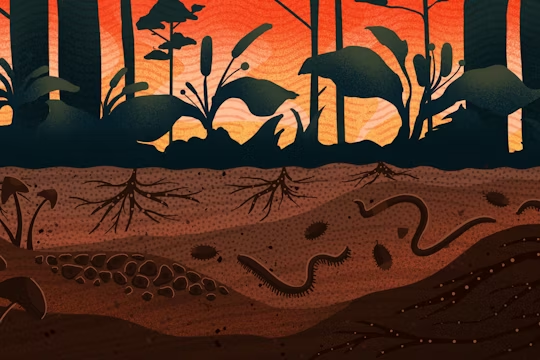
Living on the Sunshine Coast, we are surrounded by breathtaking biodiversity. Walk through a coastal forest and you’re immersed in it: towering Douglas firs and Western redcedars, ferns and salal and Arbutus trees, raven and eagles overhead. We humans are deeply visual, and we tend to pay attention to the life we can see.
But beneath our feet lies a rich web of life critical to the functioning and health of our forests. Soil organisms make up what scientists estimate to be half of all the biodiversity in a forest, and this biome is more intricate, more important, and more vulnerable than most of us realize. While discussions about forest health and management generally focus on trees, wildlife, and the visible fabric of forest ecosystems, the organisms living in the soil are rarely part of the conversation. Yet these are precisely the organisms (most of them too small to see without a microscope) that perform some of the most fundamental and irreplaceable functions in a forest ecosystem.
Who Lives in the Soil?
The richness of life in soil is staggering. A single teaspoon of forest soil holds thousands of species and billions of individual organisms.
The largest soil-dwelling animals include small burrowing mammals— moles, voles, shrews— as well as amphibians and reptiles that rely on soil for shelter and overwintering. Moving down in size, invertebrates make up the majority of soil-dwelling animals: earthworms, millipedes, centipedes, beetles, mites, and springtails, alongside microscopic animals like nematodes, tardigrades, and rotifers living in the thin water films that coat soil particles.
Smaller still, and far more numerous, are the microorganisms: bacteria, archaea, fungi, and viruses that together form the soil microbiome. A single cubic centimetre of forest soil can hold more than a kilometre’s worth of fungal hyphae alone, the thread-like structures that fan out through the soil to form the sprawling networks we call mycelia.
All of this life is organized into intricate food webs, in which larger organisms consume smaller ones, and energy and nutrients flow continuously through the system. Because so much of this biome is hidden from view, it is largely overlooked in discussions around forest health and management. That is a gap worth closing– not only because these organisms are fascinating, but because they may be among our most important allies in supporting resilient forests that can withstand the pressures of a changing climate.
What Soil Organisms Do
Fungi and bacteria drive decomposition, breaking down fallen leaves, dead roots, and other organic material into nutrients that plants can absorb. Fungi are particularly powerful decomposers: their hyphae physically bind soil particles together, creating the porous, well-structured soil that holds water and allows air to circulate. Bacteria, meanwhile, carry out essential chemical processes, including converting atmospheric nitrogen into a form that plants can actually use, a process with no adequate substitute in nature.
One of the most important relationships in any forest is the one between trees and mycorrhizal fungi. These fungi colonize tree roots and extend their hyphae deep into the surrounding soil, giving trees access to far more water and nutrients than their roots alone could reach. The trees, in turn, share sugars generated through photosynthesis with the fungi. This is not simply a bilateral exchange: the carbon that moves from leaf to root to fungal network enters a vast underground food web, nourishing bacteria, protozoa, nematodes, and many other organisms within days of being captured from the atmosphere.
This flow of carbon belowground is also central to how forests store it. An estimated half of the carbon that trees fix through photosynthesis ends up underground, where soil microorganisms convert it— through their metabolism and eventually through their own decomposition —into stable forms of organic matter. A healthy, diverse soil biome is therefore not just the foundation of forest productivity; it is a critical mechanism of long-term carbon storage.
What Fire Does to Life Underground
Fire has always played a role in shaping terrestrial ecosystems. But as human activity increasingly alters fire regimes, changing how often fires occur, how large they grow, and how intensely they burn, the consequences for soil life are becoming more severe. Those consequences tend to be overshadowed in public discourse by the visible losses: burned trees, displaced wildlife, destroyed homes. The effects of fire on soil organisms attract comparatively little attention, despite their role in determining how forests recover.
Most soil organisms are concentrated in the uppermost layer of the soil (the organic horizon, rich in decomposing matter) which is also the layer most exposed to fire’s heat. Larger animals can run or burrow to safety; microorganisms and most invertebrates cannot. For them, a high-severity wildfire is largely unsurvivable where it passes.
Burn severity, defined broadly as the degree to which organic matter is lost both above and below the soil surface, is the strongest predictor of fire’s impact on soil communities. Cooler, lower-severity burns, such as prescribed burns, tend to leave soil communities largely intact. High-severity wildfires, by contrast, can cause harm that goes well beyond the direct death of organisms: the habitat itself is transformed. Nutrient pools are disrupted, food webs collapse, soil structure deteriorates, moisture regimes shift, and toxic compounds produced during combustion can remain in the soil long after the fire has passed.
Wildfires also rarely burn evenly. They move across landscapes in a patchwork; this uneven pattern, together with the already considerable natural variability of soil ecosystems, makes it difficult to study the overall impact on soil communities. Researchers have described the effect of fire on soil life as complex, highly variable, and not fully predictable— local conditions, fire behaviour, and the specific composition of the soil community all appear to matter in ways that are still being examined.
What the science does consistently show is that high-severity wildfire produces significant, long-lasting declines in the biomass and diversity of soil microbial communities, and these declines can persist for a decade or more. Fungi suffer disproportionately, and their loss carries particular consequences for forest recovery: the ectomycorrhizal fungi that young conifer trees depend on for establishment decline sharply after severe fire, creating conditions in which natural regeneration may be slowed or impaired. Meanwhile, heat-tolerant, “fire-loving” pyrophilous bacteria increase and become dominant members of the microbial community following fire.
The Consequences Run Deep
When soil communities are disrupted, the processes they sustain—nutrient cycling, decomposition, carbon storage, water regulation—are disrupted too. A forest recovering from severe wildfire is not just a forest without trees; it is a forest with a compromised underground system, struggling to perform the basic functions that make regeneration possible.
Recovery does happen. Organisms move in from unburned surrounding areas, and soil communities gradually rebuild. But full recovery can take many decades, and as wildfires become more frequent and more severe, the time available to recover between disturbances shrinks. Forests of different ages support different soil communities; old-growth forests harbour organisms not found in younger stands. Maintaining the full diversity of belowground life therefore requires maintaining forests across a range of ages, which is something that becomes harder as both wildfires and industrial harvesting promote younger, more uniform forests.
Protecting the Invisible
The SCCA’s mandate is to preserve and restore biodiversity, and that biodiversity extends well below the surface. The organisms living underground, most of them invisible to us, are what make so much of the visible life above possible.
Research in this area is moving quickly. DNA sequencing technologies are giving scientists an unprecedented ability to identify which soil organisms are present, how communities shift after disturbance, and what those shifts mean for forest function. These same tools are beginning to inform practical restoration approaches, helping land managers evaluate whether interventions like introducing beneficial microorganisms or amending soils with organic matter can meaningfully accelerate recovery after wildfire.
The more we understand and value the life beneath our feet—the bacteria cycling nitrogen, the fungi connecting trees, the invertebrates aerating and enriching the soil—the better equipped we are, as communities, land managers, and stewards, to protect it.