
The Province Wants to Speed Up Project Approvals — At What Cost?
The Province of British Columbia is seeking feedback on a proposed expedited environmental assessment process for major projects. The public engagement is open until April 13, 2026.
Take action now: https://engage.eao.gov.bc.ca/xEA
At its core, this proposal is about speed. But when it comes to major industrial projects, faster decisions rarely lead to better outcomes.
The Province’s discussion paper proposes completing environmental assessments in approximately 20 months, compared to timelines that can currently take several years.
Recent analysis from Ecojustice raises concerns that this approach could weaken environmental safeguards.
What’s at Stake
Environmental assessments are one of the primary tools used to identify risks, evaluate impacts, and establish mitigation measures before major projects proceed.
Compressing timelines and narrowing the scope of review raises serious concerns about whether key issues—such as cumulative effects, long-term impacts, and meaningful participation—can be adequately addressed.
There is also a growing concern that environmental assessments are not consistently capturing the full scope of projects.
In some cases, projects are assessed on a single scale, while the infrastructure, energy demand, and long-term planning associated with them point to something much larger.
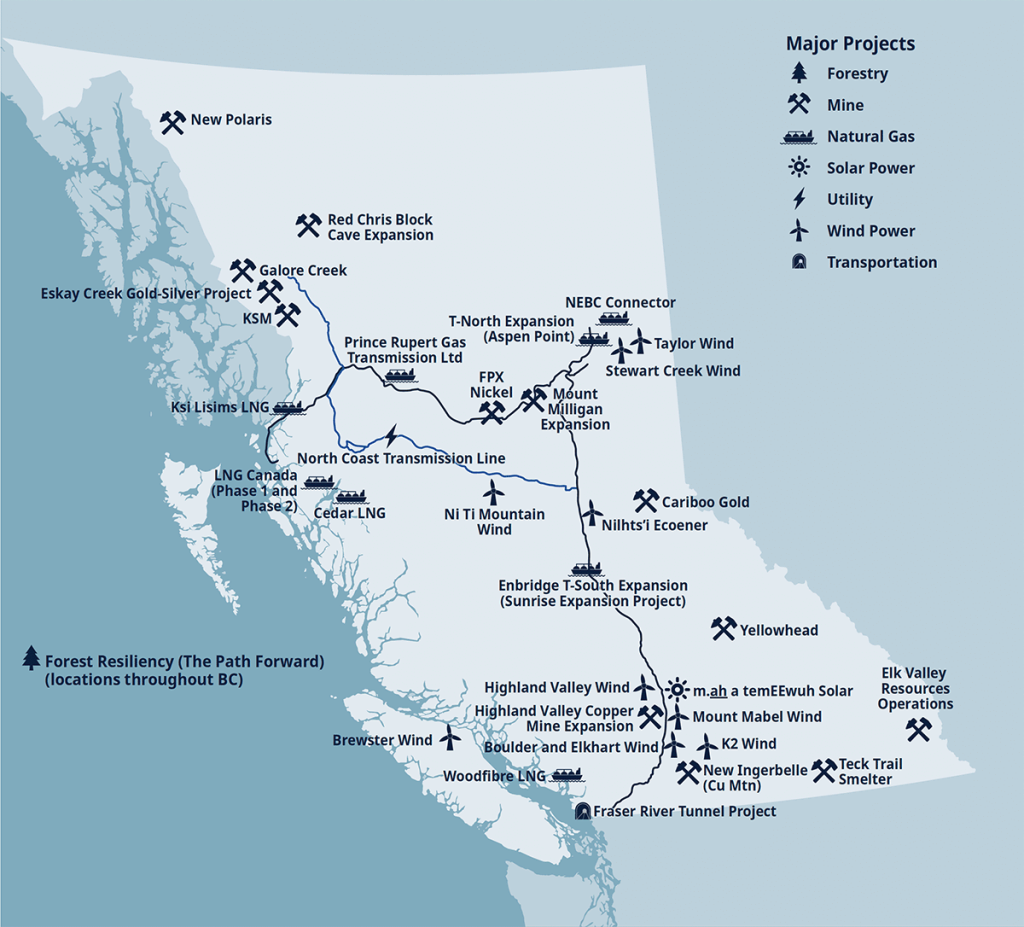
The Woodfibre LNG project is a clear example. It was approved as a 2.1-million-tonnes-per-year (Mtpa) facility. But as of today:
- Federal officials have discussed with project proponents expanding it by three times, to roughly 6.3 Mtpa
- FortisBC’s long-term planning models it as a major industrial load of approximately 110 petajoules per year by 2028
- The Eagle Mountain–Woodfibre Gas Pipeline was assessed separately, despite being essential to the project
Taken together, this raises a critical question:
Are projects being fully assessed at their true scale—or in pieces that obscure their cumulative impacts?
For a detailed breakdown of this issue, see My Sea to Sky’s analysis: https://myseatosky.org/
A briefing from Northern Confluence and SkeenaWild adds further context. It shows that environmental assessments are not the primary cause of project delays, pointing instead to economic factors like market conditions and investment cycles.
How the Process Works
Right now, this is a policy development and public engagement process.
The Environmental Assessment Office has released a proposed framework and is inviting feedback from the public, Indigenous Nations, organizations, local governments, and industry.
In practical terms:
- The Province releases a proposed framework
- The public submits feedback
- Government reviews submissions
- The Province decides whether and how to proceed
This is a critical moment to influence how major projects will be assessed in British Columbia.
Project Scope and the “Trojan Horse” Problem
A growing concern in British Columbia is what some describe as a “Trojan Horse” dynamic in project approvals.
This happens when a project is assessed at a limited scale, while the infrastructure, energy demand, and long-term planning behind it point to a much larger system.
The Woodfibre LNG example shows how this can unfold:
- a project is approved at a defined capacity
- essential infrastructure is assessed separately
- long-term planning reflects significantly higher demand
- expansion becomes possible without a full reassessment
The result is structural, not hypothetical.
The project that is ultimately built may differ significantly from what was originally assessed.
This undermines the purpose of environmental assessment.
If the full scale of a project is not evaluated upfront, then cumulative effects, climate impacts, and long-term risks are not fully understood when decisions are made.
In this context, speeding up environmental assessment does not solve the problem—it reduces the system’s ability to detect it.
Why This Moment Matters
The Sunshine Coast Conservation Association’s work is grounded in care for place, respect, and reconciliation.
Our work takes place within the territories of the Sḵwx̱wú7mesh, shíshálh, Tla’amin, Klahoose, and Homalco First Nations.
The Declaration on the Rights of Indigenous Peoples Act (DRIPA) affirms the principle of free, prior and informed consent. Indigenous Nations have the right to make decisions about what happens in their territories, based on their own laws and governance.
Environmental assessments are one of the primary processes where these decisions are engaged.
If timelines are compressed or scope is narrowed, the conditions for meaningful engagement—and informed decision-making—will be weakened.
This is not about one project. It is about the rules that will shape future decisions across the province.
Economic Implications
There is a clear economic case for maintaining strong environmental assessment.
Major projects in sectors such as mining, energy, and infrastructure entail complex, long-term risks. Environmental assessments are one of the primary tools for identifying and managing those risks.
Weakening the process increases the likelihood that risks will be underestimated or deferred—resulting in higher long-term costs, environmental damage, and loss of public trust.
Working for Watersheds’ economic case study provides one example. Healthy watersheds support infrastructure resilience, economic stability, and community well-being. BC’s water technology sector includes 90 companies, supports approximately 40,000 jobs, and operates within a $508 billion global market. Water-related climate risk alone is projected to cost Canada up to $139 billion by 2050.
The costs of getting it wrong are just as clear.
The Woodfibre LNG example shows how risk can enter the system through fragmented assessment, evolving project scope, and infrastructure reviewed in isolation.
Mount Polley shows what happens when those risks are not fully identified and managed.
In 2014, the Mount Polley tailings dam failure released approximately 25 billion litres of mine waste into surrounding lakes and waterways—one of the largest environmental disasters in Canadian mining history.
Investigations found the failure was linked to design and structural issues that were not identified or addressed in advance.
The consequences were not short-term, and they were not isolated.
Strong environmental oversight is not a barrier to economic growth. It is a condition of long-term economic resilience.
Take Action
Submit your feedback here: https://engage.eao.gov.bc.ca/xEA
Deadline: April 13, 2026
Even a short submission helps ensure environmental and community perspectives are part of the record.
You may want to emphasize:
- Environmental assessments must remain robust and science-based
- Cumulative effects and long-term impacts must be fully assessed
- Healthy ecosystems and watersheds are essential to climate resilience
- Public participation must be meaningful
- Indigenous rights and title must be respected and upheld
- Transparency and accountability must be strengthened
- Projects must be assessed at their full scale, including associated infrastructure and foreseeable expansions
Copy-and-paste submission bullets:
- I am concerned that the proposed expedited environmental assessment process could weaken environmental safeguards in British Columbia.
- Environmental assessments must fully consider cumulative effects, long-term ecological impacts, and climate risks.
- Expediency should not come at the cost of ecological integrity, watershed health, or biodiversity.
- Shortened timelines should not reduce meaningful participation by Indigenous Nations, communities, and independent experts.
- Public trust depends on transparency, accountability, and a credible assessment process.
- Environmental assessment processes must support meaningful engagement and free, prior and informed consent, consistent with UNDRIP and DRIPA.
Decisions made now will shape how major projects are assessed in British Columbia for years to come. The time to comment is now.
Resources to Support Your Input
Environmental Assessment Office engagement:
https://engage.eao.gov.bc.ca/xEA
Provincial discussion paper:
https://www2.gov.bc.ca/assets/gov/environment/natural-resource-stewardship/environmental-assessments/new-environmental-assessments/act-review/expedited_environmental_assessment_discussion_paper.pdf
Ecojustice analysis:
https://ecojustice.ca/news/cutting-corners-to-fast-track-b-c-is-at-risk-of-compromising-environmental-safeguards-with-proposed-expedited-environmental-assessments/
Organizing for Change guide:
https://www.organizingforchange.org/xea
Working for Watersheds case study:
https://www.workingforwatersheds.ca/post/economic-case-study-watershed-technology
Northern Confluence and SkeenaWild briefing: shared through coalition partners